English
 Polish
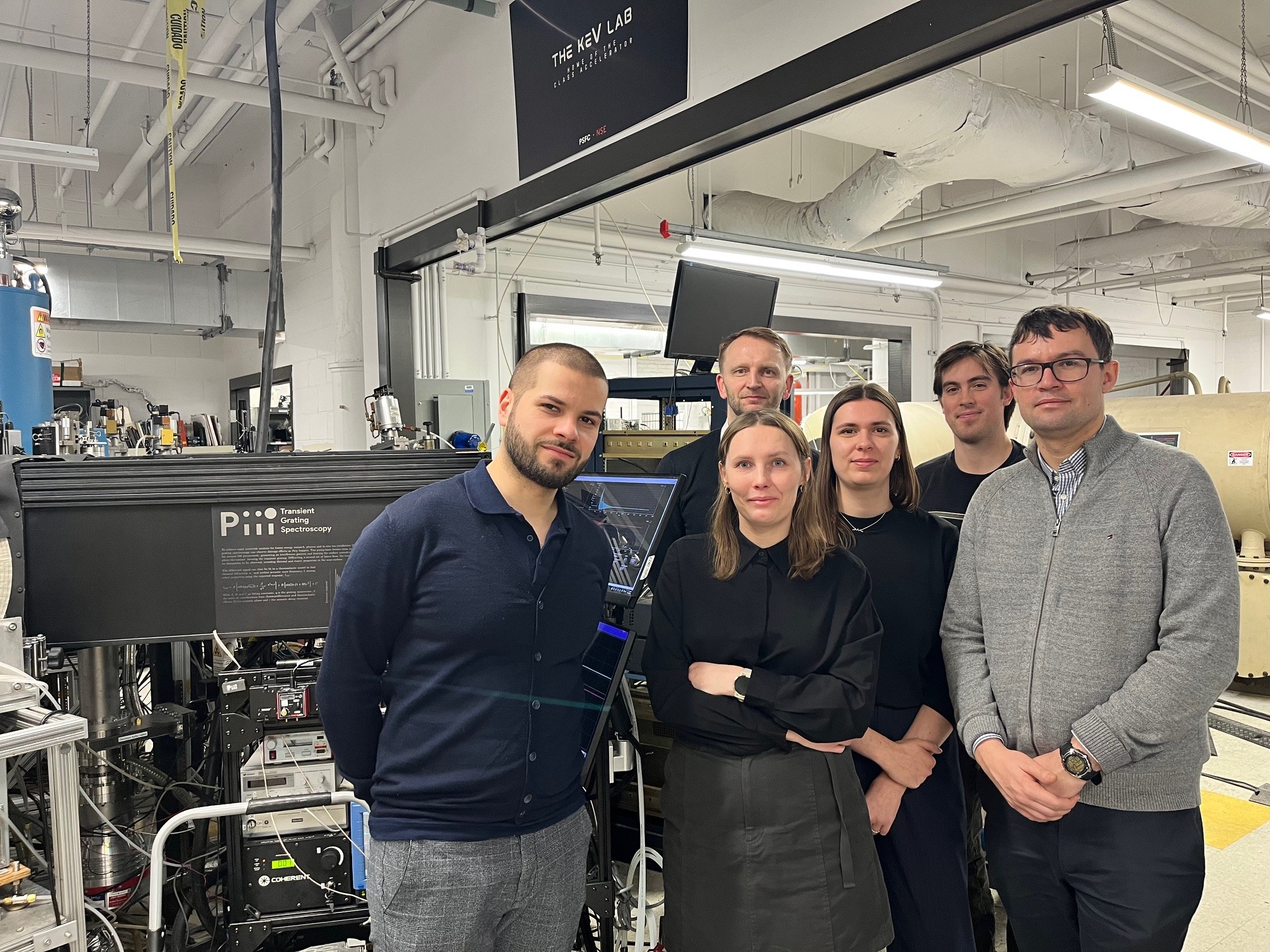
A team of scientists from NCBJ hold lectures at the Department of Nuclear Engineering at MIT
19-12-2025
At the beginning of December, representatives of the NOMATEN Centre of Excellence and the Materials Research Laboratory of the National Centre for Nuclear Research visited the Department of Nuclear Engineering at the Massachusetts Institute of Technology (MIT) in the United States. Researchers from NCBJ gave a series of lectures on high-entropy alloys for use in Generation IV reactors. The visit was an opportunity to strengthen cooperation between the two institutions.
During the lectures, specialists from NCBJ presented the latest data on the remarkable properties of high-entropy alloys (HEAs), materials that are created by combining five or more elements. The work carried out at the Institute aims to optimise their chemical composition, which allows their specific functional properties to be influenced or even designed. The alloys produced in this way can be characterised by high resistance to corrosion and radiation. Such extreme conditions will be prevalent in fourth-generation nuclear reactors, where they will be used. The materials whose properties were discussed by NCBJ representatives can also be used in molten salt reactors (MSR) or lead-cooled fast reactors (LFR).
Scientists from the NOMATEN Centre of Excellence and the Materials Research Laboratory discussed, among other things, the mechanical properties and high structural stability of the tested materials under the influence of high temperatures and radiation defects. Part of the presentation focused on a special type of HEA alloys with no cobalt added – the researchers explained the mechanisms of deformation and segregation occurring in them and their high corrosion resistance. The possibilities of manufacturing and optimising the production costs of new materials were also presented. The series of lectures showed that optimising the chemical composition and microstructure of the designed alloys makes it possible to create new materials with unique functional properties. Of particular importance is the increased resistance to radiation, which makes high-entropy alloys a promising candidate for use in the construction of a new generation of nuclear reactors.
During the visit, NCBJ representatives had the opportunity to see MIT laboratories, in particular the world's only high-energy ion accelerator coupled with a transient grating spectroscopy (TGS) system. This device allows for the study of the impact of in-situ radiation defecting on the mechanical and thermal properties of materials. The study visit by the NCBJ team allowed for further strengthening of cooperation between the institutions. The first joint scientific paper has already been published in the prestigious journal Materials Science and Engineering Part A 945 (2025) 149058, and more are in preparation. In addition, next year will see a visit by researchers from MIT to NCBJ, which will result in new joint scientific work. There are also plans to acquire new research projects, which will enable the effective use of the research potential of both centres involved in the development of nuclear energy.
The lectures were given by:
dr hab. inż. Łukasz Kurpaska - Superior radiation damage resistance of ODS-NiFeCoCr high entropy alloys at high temperature
dr inż. Tomasz Stasiak - Microstructure, mechanical properties, and irradiation resistance of FeCrAl ODS alloys for parts of GenIV nuclear reactors exposed to high temperature
mgr inż. Agata Zaborowska - Thermal stability and ion irradiation response of a Co-free FCC FeCrMnNiAl high entropy alloy oraz Effects of radiation and temperature on the performance of PLD-grown alumina coatings dedicated for LFR
mgr inż. Katarzyna Ciporska - Corrosion resistance of CO-free FeCrMnNiAl high entropy alloy
mgr inż. Artur Olejarz - The Effect of Strengthening Precipitates on Microstructure, Mechanical and Functional Properties of CoCrFeNi Multiprincipal Element Alloys
The visit was organised as part of a project financed by the MIT-Poland Lockheed Martin Seed Fund: „Radiation Damage Resistance Prediction via Potential Energy Landscapes”.