English
 Polish

NCBJ Scientists Study New Material for Detection of Three Types of Radiation
22-05-2026
Scientists from the National Centre for Nuclear Research (NCBJ) have investigated the properties of a new scintillation material that could be used in advanced radiation detectors capable of simultaneously distinguishing between several types of radiation. The research results were published on 26 March 2026 in the international journal Journal of Instrumentation (DOI: 10.1088/1748-0221/21/03/P03049).
The publication was authored by researchers from several scientific institutions in Poland and the United States. The National Centre for Nuclear Research was represented by M. Grodzicka-Kobyłka, L. Adamowski, T. Szczesniak and K. Brylew. The study also involved Vasyl Stasiv and Yaroslav Zhydachevskyy from the Institute of Physics of the Polish Academy of Sciences, as well as Olusegun Falana from the American company Eljen Technology.
The research focused on a material designated EJ-250 — a scintillation plastic intended for the detection of ionizing radiation. Materials of this type emit short flashes of light when interacting with radiation, enabling the analysis of the type of detected particles.
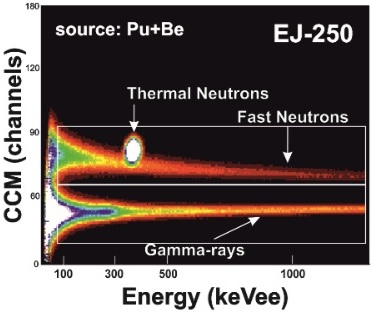
The aim of the study was to determine whether EJ-250 could be used for the simultaneous discrimination of three types of radiation: gamma rays, fast neutrons and thermal neutrons. Particular attention was paid to achieving good radiation identification performance while maintaining the potential for constructing relatively inexpensive large-volume detectors.
“Our goal was to investigate whether it is possible to combine the detection of thermal neutrons, fast neutrons and gamma radiation in a single plastic scintillation material that could also be used in larger active volumes while remaining a relatively simple technological solution,” says Prof. M. Grodzicka-Kobyłka.
EJ-250 contains the lithium-6 isotope, which enables the detection of thermal neutrons. The researchers also analyzed the shapes of light pulses generated by different types of radiation. Since gamma rays, fast neutrons and thermal neutrons produce signals with different temporal characteristics, they can be distinguished using the pulse shape discrimination (PSD) method.
As part of the study, EJ-250 was compared with other materials used in radiation detection. The researchers analyzed, among other things, signal separation capability, scintillation light properties and the potential applicability of the material in large-scale detectors.
The results indicate that EJ-250 may be a promising candidate for the construction of detectors capable of simultaneously identifying three types of radiation. Particularly important was the possibility of combining the detection of thermal and fast neutrons in a single material while maintaining properties enabling signal discrimination using digital methods.
Technologies of this kind may find applications in radiation monitoring, scientific research, nuclear energy and detection systems requiring large active volumes and simultaneous identification of different radiation types.
The authors emphasize that the obtained results represent another step toward the development of cost-effective scintillation detectors capable of simultaneously distinguishing multiple types of radiation.