English
 Polish
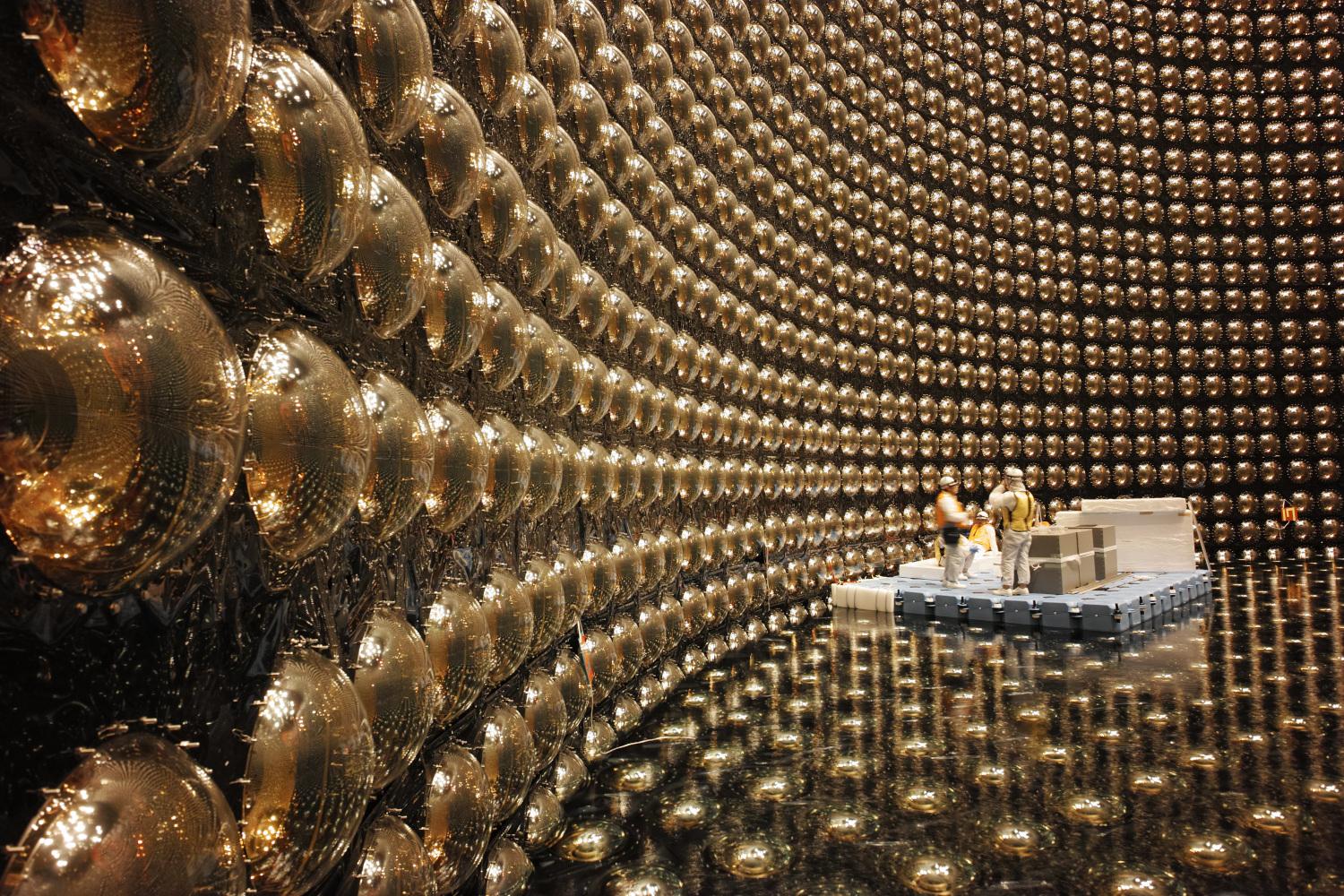
30th anniversary celebrations of the Super-Kamiokande experiment are about to begin
18-05-2026
Super-Kamiokande, the giant water-based neutrino detector, is celebrating its 30th anniversary this year. From 18 to 22 May, an international meeting of scientists is taking place in Japan to discuss the physical analyses carried out as part of the experiment. On Saturday 23 May, the official 30th-anniversary celebration of the experiment will take place. Dr Joanna Zalipska from the High Energy Physics Division of the National Centre for Nuclear Research (NCBJ) is taking part in the event, representing the Warsaw Neutrino Group, together with colleagues from the University of Warsaw.
The Super-Kamiokande experiment consists of a huge cylindrical tank of ultra-pure water (currently containing gadolinium salt) that measures neutrino interactions using Cherenkov radiation, which is detected by 11,000 photomultipliers, each half a metre in diameter, installed on the inner walls of the pool. The detector is located in Japan, inside Mount Ikenoyama, 1,000 metres underground. The neutrinos we measure there are among the elementary particles of the Standard Model, characterised by zero charge, very low mass and an extremely small cross-section for interactions, making them very difficult to study.
Super-Kamiokande is a leading experiment in the physics of neutrinos originating from the Earth’s atmosphere, as well as those arriving from the Sun. It has contributed to research into the effect of neutrino type (known as flavour) change, or their so-called oscillation. In 1998, the experiment discovered the existence of atmospheric neutrino oscillations, for which the 2015 Nobel Prize was awarded to Prof. Takaaki Kajita of the University of Tokyo. In addition to measuring atmospheric and cosmological neutrinos, this detector is also used to study neutrinos produced by the accelerator at the JPARC laboratory. The Neutrino Group from our Institute is also participating in this experiment, known as T2K (Tokai to Kamioka).