English
 Polish
NCBJ scientists open a new path to studying the internal structure of mesons
18-05-2026
An international team of physicists, including Prof. Lech Szymanowski from the National Centre for Nuclear Research, has proposed a new method for studying the internal structure of mesons — one of the fundamental particles that make up matter.
The research findings were published on 6 May 2026 in the prestigious journal Physical Review D.; DOI: https://doi.org/10.1103/rl5q-5h2n
Mesons are very small and short-lived particles composed of a quark and an antiquark. Although they exist for only a very short time, they play an important role in research into the fundamental forces governing matter. Thanks to them, physicists are attempting to understand how quarks and gluons — the smallest known constituents of matter — form more complex particles, such as protons, neutrons and mesons.
The authors of the paper presented a new method for studying the so-called internal structure of two-meson states, i.e. the way in which the particles within them move and interact with one another. It is particularly important to understand the relationship between the spin of particles and their motion. Spin can be compared to a particle’s internal "rotation", which influences its physical properties.
Until now, some of these phenomena have remained virtually inaccessible experimentally. The researchers have shown for the first time that it may be possible to observe so-called chiral-odd meson distribution amplitudes — very subtle effects describing the behaviour of quarks within two-meson systems. These are among the least understood aspects of modern particle physics.
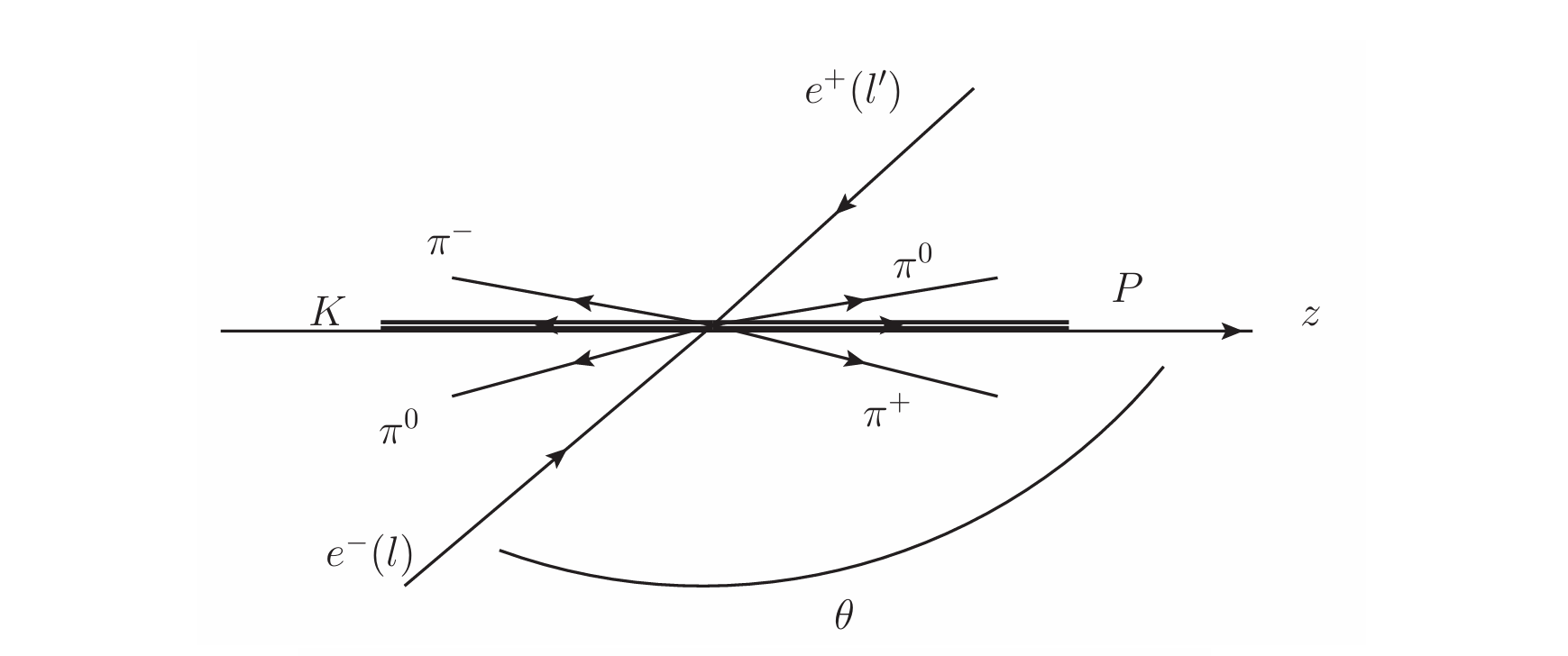
The team has developed a method that utilises collisions between electrons and positrons in particle accelerators. When an electron and a positron—its antiparticle—collide, they can produce pairs of mesons. The researchers have shown that analysing such processes can reveal new information about the structure of matter.
The phenomenon of interference, i.e. the superposition of various quantum processes, is of key importance here. The researchers have shown that comparing processes involving one and two photons may allow the detection of signals associated with previously unobserved properties of mesons.
According to the authors, such research could be conducted, for example, in the BES III experiment in China and in future next-generation electron-positron colliders.
The contribution of scientists associated with the National Centre for Nuclear Research (NCBJ) primarily concerned the development of the theoretical foundations of the proposed method and the analysis of quantum processes describing the structure of mesons. The study forms part of one of the most important areas of modern particle physics — the attempt to create an "internal map" of hadrons, i.e. particles composed of quarks and gluons.
– This work addresses one of the fundamental problems of modern science: how the interactions of the smallest constituents of matter give rise to the properties of the observable world. Protons and neutrons have been studied for decades, but mesons remain much less well understood because they are highly unstable and difficult to study directly – explains Prof. Lech Szymanowski.
The significance of such research extends beyond particle physics. The advanced mathematical methods, computer models and data analysis techniques developed in the course of this work are subsequently applied in areas such as new computing technologies, big data analysis and imaging methods used in science and medicine.
According to the authors, the proposed method may in the future become an important tool for studying the structure of matter and help us better understand the fundamental laws governing the Universe.