English
 Polish
NCBJ becomes a partner in a nationwide program to develop personnel for the nuclear energy sector. The start of the 4NEW project
01-04-2026
The launch of a collaboration between universities, research institutions, public administration, and industry marks an important step in Poland’s preparations for the development of nuclear energy. The launch of this project, which aims to train specialists and build a talent pool, will help ensure a sufficient workforce for one of the economy’s key sectors.
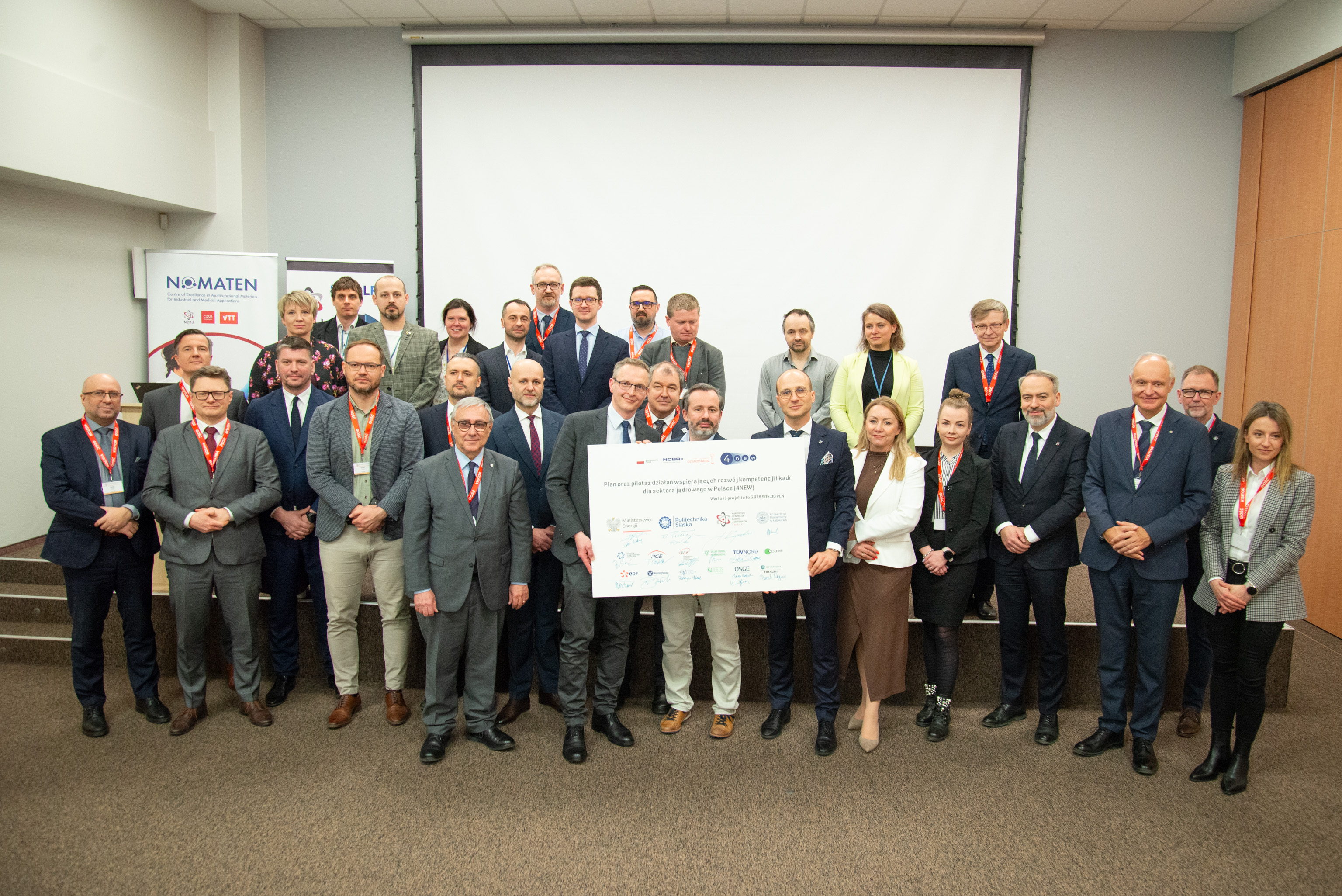
On April 1, 2026, a ceremonial meeting was held at the National Centre for Nuclear Research to launch the project titled “Plan and Pilot Program for Activities Supporting the Development of Competencies and Human Resources for the Nuclear Sector in Poland (4NEW)”, funded under the Strategic Program for Scientific Research and Development “Social and Economic Development of Poland in the Context of Globalizing Markets” – GOSPOSTRATEG XII competition.
The 4NEW project received funding from the National Center for Research and Development (NCBR) under an agreement dated March 20, 2026. The total cost of the project is PLN 6,978,905.00, of which PLN 6,863,705.00 (98.35%) is grant funding.
– The entire nuclear energy strategy is of great importance to the government. This project, which is currently being developed, brings us closer to making nuclear energy a permanent fixture in Polish industry and in Polish homes. It is the cleanest energy we can use. The MARIA reactor, co-funded by us together with the Ministry of Energy, is a convergence of science, the economy, and industry – the priorities of the Ministry of Science and Higher Education, – said dr inż. Marcin Kulasek, Minister of Science and Higher Education.
The National Center for Research and Development, as the institution funding the project, emphasizes the importance of the initiative for the country’s innovation policy. It also highlights the role of strategic programs in building competencies for key sectors of the economy. – We are currently launching the GOSPOSTRATEG training program, which aims to identify certain competency gaps, institutional weaknesses, or demographic gaps. This program is dedicated to research and development, but also to innovation. The NCBR’s mission is to connect science with the economy, society, and business. One of the four strategic directions important to the NCBR is the energy transition – said Prof. Jerzy Małachowski, Director of the National Center for Research and Development.
The project will last three years. The goal of the initiative is to develop specific legal, financial, and organizational solutions to support the development of human resources for the nuclear sector in Poland. The Ministry of Energy will be responsible for implementing these solutions.
Preparing a qualified workforce for the growing nuclear sector is one of the most important challenges of Poland’s energy transition. According to national plans for the development of nuclear energy through 2040, a shortage of properly trained specialists could be a significant constraint. The 4NEW project aims to counter this risk by creating a comprehensive model for the development of competencies and personnel.
A key outcome of the project will be the Ministry of Energy’s preparation of a package of systemic recommendations – including legislative, financial, and organizational measures – that can be implemented at the national level. The Ministry of Energy’s statement emphasizes the project’s importance to the success of the entire nuclear program. The Ministry highlights the need for a systemic approach to building expertise. – The key beneficiaries of this project will be those implementing the findings of the 4NEW project, namely educational institutions – a large group of universities, research institutes, specialist schools, and technical colleges. Training personnel for the nuclear sector is a comprehensive system in which we must reconcile the needs of many stakeholders, address the needs of various audiences, and educate specialists in various fields: from nuclear engineers to management and legal specialists, and many others. We want the 4NEW project to result in the development of concrete solutions related to education, training, and professional development, thanks to which we will be able to successfully build a Polish nuclear industry. This will be possible thanks to properly qualified personnel – said dr inż. Paweł Gajda, Director of the Department of Nuclear Energy at the Ministry of Energy.
The project aims to develop a coherent, knowledge-based system for education and skills development, encompassing three key pillars: secondary education, higher education, and lifelong learning.
The project leader highlights the scale of the challenge and the need to integrate various communities. He also emphasizes the practical nature of the solutions being developed. – The 4NEW project is a response to one of the most demanding challenges facing the Polish energy sector – ensuring a sufficiently trained workforce for the nuclear sector. Our goal is to develop a model that is coherent and implementable on a national scale, integrating educational, research, and industrial activities – said Prof. Marek Pawełczyk, Rector of the Silesian University of Technology.
The project will involve eight research and development tasks, including competency assessments, the development of pilot educational programs and teaching materials, and the creation of digital tools to support workforce development.
In the context of research, it is crucial to align the education system with market needs. Experts also highlight the role of new technologies in the educational process. – The project enables a comprehensive assessment of competency needs and the development of modern educational pathways tailored to the specific nature of the nuclear sector. Integrating expert knowledge with market requirements and utilizing digital tools in the educational process are of key importance – said dr hab. Łukasz Bartela, professor at the Silesian University of Technology and head of the 4NEW project.
The National Centre for Nuclear Research highlights its role as the project’s expert and research support base. The institution emphasizes the importance of coordinating activities at the national level. – The implementation of the 4NEW project is part of strategic efforts to develop expertise in the field of nuclear energy. The National Research Centre for Nuclear Research has unique research and expert resources that provide significant support for the development of a national workforce training system – said Prof. Wacław Gudowski, the project manager on behalf of the NCBJ.
The importance of cooperation between science and industry is one of the key themes of the project. The implementation of the Polish Nuclear Energy Program can only succeed if all stakeholders in the process cooperate intensively, and only well-coordinated actions can ensure lasting results. – The development of nuclear energy in Poland requires building partnerships and integrating research, education, science, and industry, and above all, moving from theory to practice. For this reason, the involvement of the National Centre for Nuclear Research and the availability of the MARIA nuclear reactor as a training facility within the 4NEW framework are so crucial. We are carrying out our training and educational mission, but we define specific actions closely in line with economic needs, and the number of stakeholders in this project will gradually increase – emphasised Prof. Jakub Kupecki, Director of the National Centre for Nuclear Research.
The involvement of a business school broadens the project’s scope to include managerial and financial aspects. This underscores the need for an interdisciplinary approach. – When we think about the development of nuclear energy, we all talk about developing technical personnel. People who will be able to carry out these projects from both an investment and operational perspective. We also need experts across the entire ecosystem who possess economic and legal expertise. The University of Economics in Katowice will be responsible for this task in the project. We are to assess what economic competencies are needed in this project not only for investors but also for public institutions and organizations – said Prof. Maciej Nowak, Vice Rector for Science and Academic Staff Development at the University of Economics in Katowice.
The 4NEW project consortium received strong support during the funding application phase, securing 12 letters of intent from key institutions and companies that explicitly support the development of a domestic nuclear sector. The industry’s perspective focuses on the practical application of expertise and the availability of specialists. Companies emphasize the need for close cooperation with the education system. – As Bechtel Polska – together with Westinghouse – we are proud to be building Poland’s first nuclear power plant. We have no doubt that even the best project cannot be realized without the right personnel. The project itself anticipates the involvement of 10,000 construction workers and over 2,000 engineering staff at the construction site. These are the professionals who can build not only the first nuclear power plant, but also the nuclear sector in Poland. Our ambition is to support not only the project itself, but also a new sector that will be one of the driving forces of the Polish economy – emphasised Leszek Hołda, President of Bechtel Polska, one of the industrial partners of the 4NEW project
The 4NEW project is a key element of Poland’s preparations for the development of nuclear energy, integrating the efforts of public administration, the scientific community, and industry. The solutions developed within its framework are intended to contribute to the creation of a sustainable and effective workforce development system that meets the needs of one of the economy’s key sectors over the coming decades.