English
 Polish
Researchers from NCBJ and SGGW improve the durability of tools through ion implantation
26-03-2026
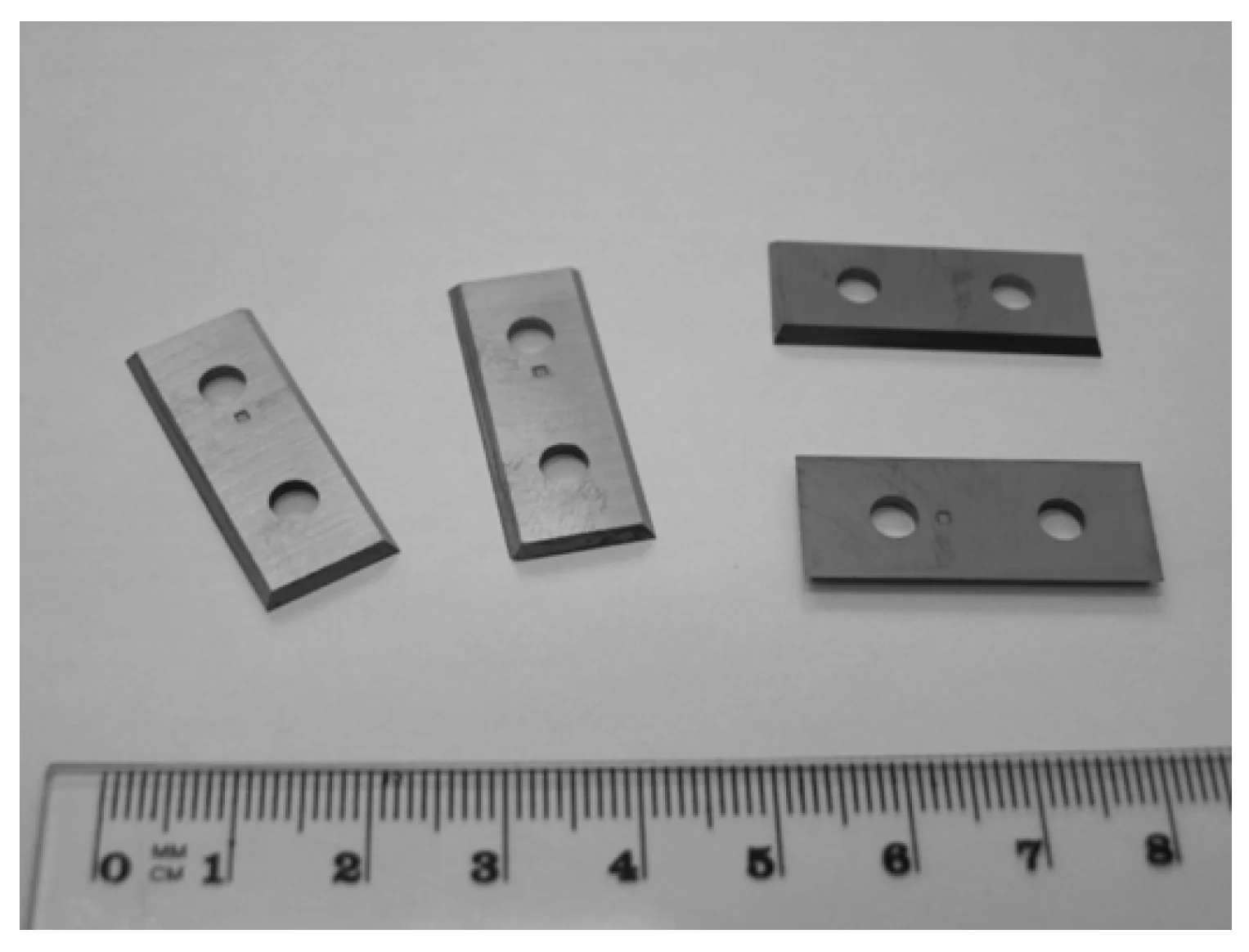
Tool life is a key aspect of optimising manufacturing processes in industry. Depending on the industry, tool material wear can be influenced by a number of factors, which must be thoroughly understood in order to predict tool life and propose the best method for extending it. In their latest publication, a team of researchers from the National Centre for Nuclear Research (NCBJ) and the Warsaw University of Life Sciences (SGGW) presented the results of their research into the effect of nitrogen ion implantation on the wettability of WC-Co blades used in the machining of wood-based furniture panels.
Ion implantation is a surface modification technique that can change the physicochemical properties of a material. The new ions are deposited directly into the near-surface layers, which eliminates potential issues with layer adhesion and does not alter the dimensions of the modified component. As a result, the method can be applied to tools that have already been manufactured, without the need to integrate it into their production process.
An area where ion implantation can effectively increase tool life is the furniture industry. The quality and durability of cutting blades directly affect efficiency, manufacturing costs and the quality of the final product. Tools made from a sintered tungsten carbide and cobalt (WC-Co) composite are commonly used in this industry. This material is more durable than ordinary steel, yet cheaper than diamond blades. Work is currently underway to further increase the durability of WC-Co tools, for example by modifying their surface using ion implantation. The introduction of additives can reduce the coefficient of friction, and thus the rate of wear of the modified tools, as it has been observed that a secondary carbon layer forms on the blades of the implanted tools during operation. This reduces the coefficient of friction in the tribological contact between the cutting edge and the workpiece, thereby slowing down the tool wear process. Theoretically, the higher the wettability of the modified tool, the more favourable the conditions for the formation of this layer.
As part of a collaboration between the National Centre for Nuclear Research and the Institute of Wood Science and Furniture at the Warsaw University of Life Sciences, researchers have investigated the effect of nitrogen ion implantation on the wettability of the surfaces of modified tools made from a WC-Co composite. The results of this work have just been published in the scientific journal Materials.
The ion implantation itself was preceded by Monte Carlo simulations designed to predict the distribution of ions in the near-surface layers of the modified material. Furthermore, the surface roughness of the implanted blades was characterised. The main part of the study involved measuring the water contact angle of the tools. Drops of distilled water were placed on the samples, after which the angle formed by the tangent to the contour of the drop and the surface under investigation was determined.
The research clearly shows that the implantation of nitrogen ions significantly increases the wettability of the blade surfaces, with a higher dose of ions further enhancing this effect. – For the highest dose, the average contact angle decreased by as much as 70%. Furthermore, it turned out that this effect diminishes over time following implantation, yet the wettability of the implanted samples still significantly exceeds that of samples that were not modified – explain dr inż. Marek Barlak from the National Centre for Nuclear Research and dr inż. Jacek Wilkowski from the Warsaw University of Life Sciences, the lead authors of the publication.
This latest study once again demonstrates that ion implantation can be an effective method for increasing the durability of tools used in the furniture industry. It also provides evidence that the wear of such materials depends on many properties, which the implantation process can significantly influence.
The research results were published in the article: Barlak, M.; Wilkowski, J.; Auriga, R.; Zagórski, J.; Boruszewski, P.; Borysiuk, P. Effects of Nitrogen Ion Implantation on Wettability and Surface Roughness of WC–Co Tools Used for Wood-Based Panel Machining. Materials 2026, 19, 1241. https://doi.org/10.3390/ma19061241