English
 Polish
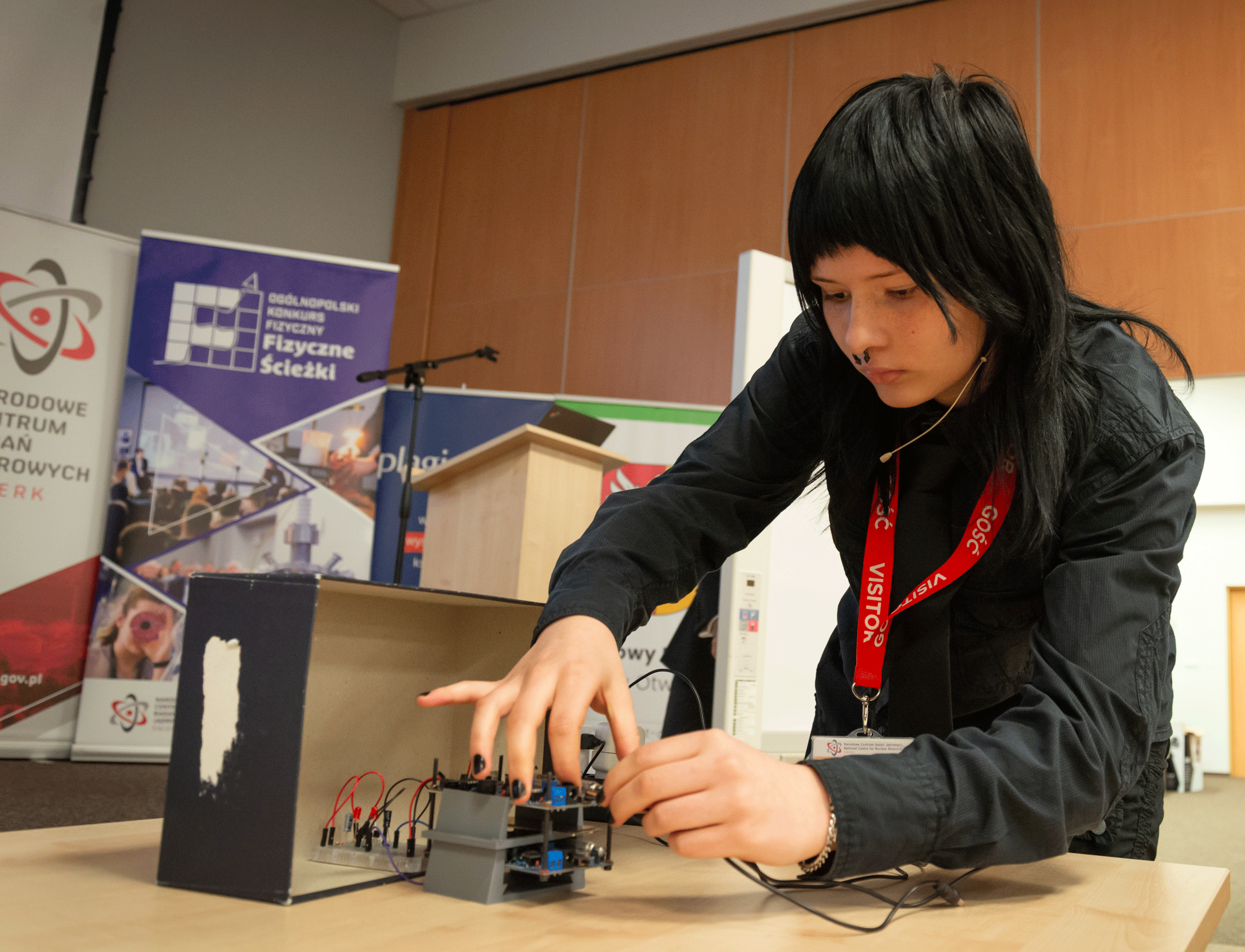
Young physicists presented their projects at NCBJ. 21st “Physical Paths” Competition concluded
20-04-2026
The final of the 21st edition of the nationwide “Physical Paths” competition took place on 17 April at the National Centre for Nuclear Research (NCBJ). Students from across Poland, along with their teachers and representatives of the scientific community and public administration, gathered in Otwock. The winners have now been announced.
The competition has been organized for over two decades – the first edition took place in 2005 – and is jointly run by NCBJ and the Institute of Physics of the Polish Academy of Sciences. “Physical Paths” is addressed to students of grades 7–8 of primary schools and secondary schools. Participants prepare scientific projects, essays, and demonstrations of physical phenomena. The best entries qualify for the final, where they present their work before a jury.
This year, first place in the “Scientific Project” category was awarded ex aequo. The winners included Zofia Makowska, a student of Stanisław Staszic 14th Secondary School in Warsaw, for her project “The role of contact geometry in parametric resonance of two pendulums based on the Riki-Tiki toy”. Equal first place was also awarded to Mateusz Oleksiński, Michał Talaśka and Weronika Grochalska from the Electrical Schools Complex in Bydgoszcz for their project “Properties of magnetic materials – studying the interaction of a diamagnet with a magnetic field under home conditions”.
Second place in this category went to Oliwier Fiszer, Szczepan Stępniewski and Wojciech Janiszewski from the Hipolit Cegielski School of Communication (Technical School) in Poznań for their project “The impact of stratospheric conditions on a microcontroller system and the reliability of temperature measurements from different digital sensors”. Third place was awarded to Krzysztof Białuk from Stefan Żeromski 1st Secondary School in Jelenia Góra for his project “The impact of selected factors on chlorophyll absorption in chives and celery”.
In the “Physics Demonstration” category, first place was awarded to Antonina Siółkowska from the Bilingual Secondary School named after Władysław Jagiełło in Płock for her project “Muon detection using Geiger–Müller tubes”. Second place went to Laura Wardziak for “Taming structure. How to stop fluttering?”. Third place ex aequo was awarded to Julia Gunia, Oliwia Wróbel and Bartłomiej Rudy from Maria Skłodowska-Curie Secondary School in Sanok for “The eye without a lens”, and to Agnieszka Derwich from Mikołaj Kopernik 3rd Secondary School in Kalisz for “Large scale in a small model: simulation of gravitational lensing”. A distinction in this category was awarded to Oskar Kotzian for “Physics and roller skates”.
In the “Essay” category, first place went to Maria Karasińska from Social Primary School No. 26 STO in Warsaw for her essay “Does physics kill magic? Or is it the greatest illusionist?”. Second place was awarded to Julia Krząstek for “Paradigm in physics – a necessary starting point or blinders?”. A distinction was awarded to Stanisław Tomaszewski for “Architecture of Nothingness – Vacuum as the foundation of physical reality”.
Congratulations to all participants!
Final
Interest in the “Physical Paths” competition continues to grow. This year, 102 works were submitted: 49 in the “Essay” category, 28 in “Scientific Project”, and 47 in “Physics Demonstration”. In total, 121 students participated under the supervision of 30 teachers. Thirteen projects qualified for the final: 4 essays, 4 scientific projects, and 5 demonstrations. Students represented 42 cities, including Warsaw, Sanok, Poznań, Piotrków Trybunalski, Dąbrowa Górnicza, Wrocław, Wodzisław Śląski, Zielona Góra and Jelenia Góra. As every year, the event was not only a competition but also an opportunity for young science enthusiasts to meet the research community.
The participants were welcomed by Prof. Agnieszka Pollo, Deputy Director of the National Centre for Nuclear Research for Scientific Affairs. Among the guests were representatives of regional authorities: Dawid Kalkowski (representing the Marshal of the Mazowieckie Voivodeship), Jarosław Lech (representing the Starost of Otwock County), and Jarosław Tomasz Margielski, Mayor of Otwock.
– “Physical Paths” is an initiative that shows young people that physics can be a space for discovery, experimentation and asking ambitious questions. The young people who come to our competition are truly remarkable – engaged, enthusiastic, knowledgeable and aware of what they are doing. The teachers and organizers are also outstanding. I hope that many of these participants will become our future employees and scientists – said Prof. Agnieszka Pollo.
– The Mazowieckie Voivodeship consistently supports educational initiatives that combine science with practice and inspire young people to develop further – noted Dawid Kalkowski.
– The involvement of young people in scientific projects shows the great potential present in local communities – emphasized Jarosław Lech.
– Otwock is a place where science and education have strong foundations. The “Physical Paths” final demonstrates how important a role our city plays in developing young talent – said Jarosław Tomasz Margielski.
Participants highlighted that the competition was above all an engaging and valuable experience.
– Taking part in the competition allowed us to carry out our own project and see how it works in practice – said one of the laureates.
– It was also very valuable to present our work to the jury and other students. It was highly motivating and gave us a lot of satisfaction – added another participant.
Teachers also emphasized the educational value of the competition.
– “Physical Paths” teaches independent thinking, research skills and how to present results – competencies that are essential both in science and in future careers – said one of the teachers.
The “Physical Paths” competition not only promotes science but also inspires young people to take on ambitious challenges and develop their research passions from an early stage. It is worth noting that being awarded the title of laureate brings tangible educational benefits, including additional points in university admissions and recognition within the academic community. The competition is also included in the official list of competitions recognized by the Ministry of Education, which further enhances its prestige and importance in the educational path of young participants.