English
 Polish

Today in “Nature”: A research team including a PhD student from NCBJ observed one of the fastest alpha decays
27-05-2026
An international team of scientists, including Aleksander Augustyn, a fourth-year doctoral student at the Doctoral School of the National Centre for Nuclear Research, has directly observed the exceptionally rapid alpha decay of tellurium-104 for the first time. The results of the study, published today in the prestigious journal Nature, show that this unstable atomic nucleus decays in a matter of nanoseconds. Tellurium-104 is the fastest known alpha emitter from the ground state.
Link to the article https://www.nature.com/articles/s41586-026-10581-w [accessible after logging in to the “Nature” platform].
The study addresses one of the fundamental questions in nuclear physics: where does an alpha particle come from within the atomic nucleus before it is emitted? An alpha particle consists of two protons and two neutrons. Physicists describe its escape from the nucleus as tunneling through a potential barrier. It is much more difficult, however, to explain how such a particle forms inside the nucleus before emission.
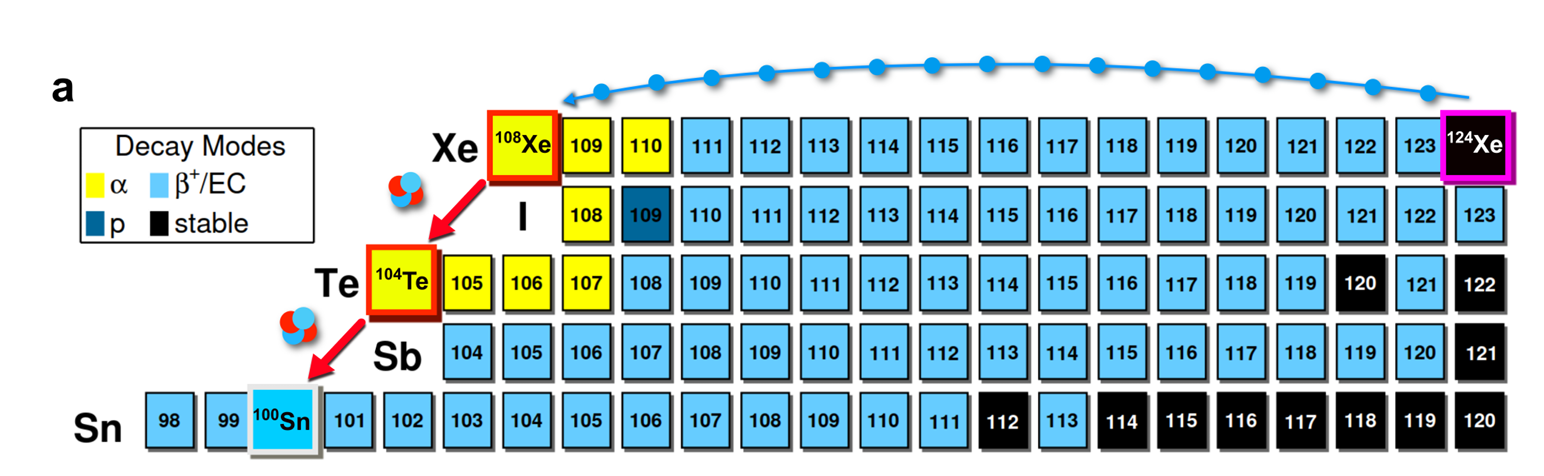
Tellurium-104 is particularly interesting in this regard. Its structure can be imagined as a tin-100 nucleus with an alpha particle “attached” to it. Tin-100 is a special nucleus: physicists call it “double magic” because both its protons and neutrons form an exceptionally stable arrangement. This can be compared to perfectly filled shelves or a closed, highly ordered structure.
That is why tellurium-104 acts as a kind of miniature laboratory for physicists. It allows them to test whether, with such a stable “core” of tin-100, an alpha particle forms more easily on the surface of the nucleus. In other words, scientists want to understand whether the alpha particle is already present in the nucleus before decay, or whether it is formed only during the emission process itself.
Tellurium-104 exists for only a very short time, but it reveals something that is not easily observed in other nuclei: the moment when nuclear matter assembles into an alpha particle before it is emitted.
The authors of the study measured the half-life of tellurium-104 and improved the accuracy of determining its decay energy. They determined that the half-life of this isotope is 7.2 nanoseconds, with an uncertainty of +2.3/−1.5 nanoseconds. This means that the nucleus decays almost immediately after formation.
The result confirms the so-called superallowed nature of the alpha decay of tellurium-104, i.e., the exceptionally high probability of alpha particle emission. According to the authors, this is the most extreme known case of the prior formation of an alpha particle within an atomic nucleus.
– Tellurium-104 is a light nucleus, but its alpha decay represents an exceptionally clear borderline case for us. The mechanism we observe here in such an extreme form — the early formation of an alpha particle inside the nucleus — can help us understand the process that governs alpha decay in heavy and superheavy nuclei. The latter do not occur in nature in a stable form and can only be produced in specialized laboratories. Alpha decay remains one of the main windows through which we can peer into their structure. That is why such an extreme measurement provides hard data for testing and calibrating the theoretical models we use to describe alpha decay — says Aleksander Augustyn, a fourth-year doctoral student at the National Centre for Nuclear Research.
The publication in Nature featuring a PhD student from the National Centre for Nuclear Research (NCBJ) is part of a broader trend of our researchers consistently contributing to articles published in the most prestigious scientific journals. In 2025–2026, scientists affiliated with the National Centre for Nuclear Research contributed to publications in the flagship journal Nature and in journals from the Nature Portfolio. The topics covered demonstrate the wide range of the institute’s expertise: from the structure of the atomic nucleus and alpha decay, through neutrino physics and questions regarding the asymmetry of matter and antimatter, to astrophysics, cosmology, and the application of computational methods in materials research.
– It is also important that young scientists from the NCBJ participate in ambitious international research projects. Aleksander Augustyn, co-author of the Nature publication on tellurium-104, is a fourth-year doctoral student at the NCBJ Doctoral School. His example shows that our doctoral students not only gain experience in projects conducted at the highest global level, but also actively participate in research that pushes the boundaries of modern physics, – emphasizes Prof. Agnieszka Pollo, Deputy Director for Science.
The study involved researchers from the USA, Japan, Poland, Germany and Spain. The authors of the paper include Ian Cox and Robert Grzywacz from the University of Tennessee at Knoxville; T.T. King, K.P. Rykaczewski, J.M. Allmond and T.J. Ruland from Oak Ridge National Laboratory; S. Nishimura, N. Fukuda, S. Go, P. Brionnet, S. Michimasa, V. Phong, H. Sakurai, Y. Shimizu, H. Suzuki, H. Takeda, Y. Togano and M. Yoshimoto from the RIKEN Nishina Center in Japan; R. Yokoyama, N. Kitamura, S. Hanai and N. Imai from the Center for Nuclear Study at the University of Tokyo; C. Mazzocchi, A. Korgul and A. Skruch from the Faculty of Physics at the University of Warsaw; A. Augustyn from the National Centre for Nuclear Research; A. Esmaylzadeh and J. Fischer from the University of Cologne; G. Garcia de Lorenzo from the Complutense University of Madrid; K. Kolos from Lawrence Livermore National Laboratory; and K. Nishio from the Japan Atomic Energy Agency.
According to the authors of the paper, future experiments should allow for even more precise measurements of the energy of the transformation and of the alpha particle formation process itself. Although tellurium-104 exists for only a fraction of a second, it could become one of the most important nuclei for testing theories describing the structure of nuclear matter.
Scientists from the U.S., Japan, Poland, Germany, and Spain participated in the research. The authors of the paper include Ian Cox and Robert Grzywacz from the University of Tennessee at Knoxville; T.T. King, K.P. Rykaczewski, J.M. Allmond, and T.J. Ruland from Oak Ridge National Laboratory; S. Nishimura, N. Fukuda, S. Go, P. Brionnet, S. Michimasa, V. Phong, H. Sakurai, Y. Shimizu, H. Suzuki, H. Takeda, Y. Togano, and M. Yoshimoto from the RIKEN Nishina Center in Japan; R. Yokoyama, N. Kitamura, S. Hanai, and N. Imai from the Center for Nuclear Study at the University of Tokyo; C. Mazzocchi, A. Korgul, and A. Skruch from the Department of Physics at the University of Warsaw; A. Augustyn from the National Centre for Nuclear Research; A. Esmaylzadeh and J. Fischer from the University of Cologne; G. Garcia de Lorenzo from the Complutense University of Madrid; K. Kolos from Lawrence Livermore National Laboratory; and K. Nishio from the Japan Atomic Energy Agency.