English
 Polish
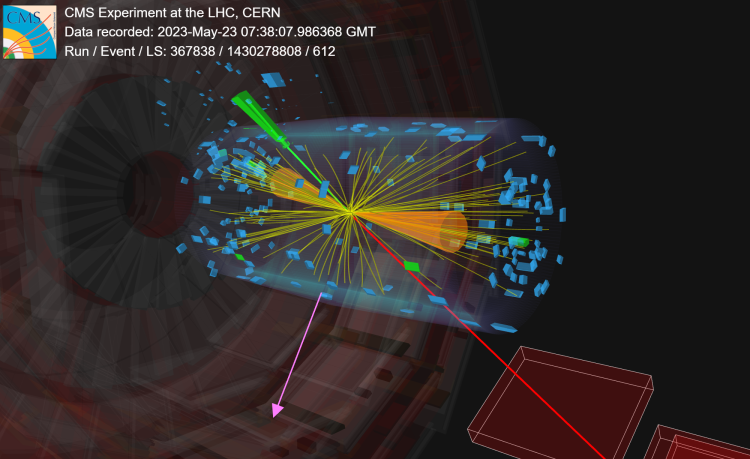
Scientists from the CMS experiment use the latest LHC data to study a rare process
27-03-2026
The CMS team — one of the main experiments at the Large Hadron Collider — has just announced new measurements of a rare process involving the production of heavy boson pairs. For the first time, the researchers used data collected at CERN between 2022 and 2024 for this purpose. Scientists from the High-Energy Physics Division of the National Centre for Nuclear Research (NCBJ) made a key contribution to the analysis.
One of the most powerful probes of the Higgs mechanism and the electroweak force is a rare process known as vector boson scattering (VBS). In this process, two heavy bosons (W or Z) are produced in high-energy proton–proton collisions, and interact with one another before flying apart. The VBS process is particularly sensitive to the internal consistency of the Standard Model. It directly tests how W and Z bosons interact with each other – including interactions involving four bosons at once, known as quartic gauge couplings. If these interactions were even slightly different from prediction, the rate of observed events would change, potentially signaling new physics beyond the Standard Model.
– Since the LHC collision energy is not expected to rise dramatically in the near future, the most promising path forward is to exploit larger datasets and improve analysis techniques to study rare Standard Model processes with high precision, and VBS is one such rare process providing strong sensitivity to new physics effects – says Monika Ghimiray, a doctoral student from High Energy Physics Division of NCBJ.
CMS has now performed the first measurements of electroweak same-sign WW and WZ production at a center-of-mass energy of 13.6 TeV using data collected between 2022 and 2024. This new energy marks the beginning of the LHC’s latest running period and allows scientists to test the theory at an unprecedented scale. The analysis focuses on two channels: the production of two W bosons with the same electric charge, and the production of a W and a Z boson. The same-sign WW channel is especially valuable because it has fewer background processes that could mimic the signal.
To identify these rare events, researchers look for collisions producing either two same-charge leptons (electrons or muons) or three charged leptons, along with missing momentum from neutrinos and two energetic particle jets. A defining feature of VBS is that the jets are widely separated and have a large combined mass, a signature that helps distinguish electroweak production from the more common strong-interaction processes that can produce similar final states.
Advanced statistical techniques are used to separate signal from background and to measure the production rates, or cross sections. As a result, clear observations of both processes at 13.6 TeV are achieved, with statistical significance well above the standard discovery threshold. In addition to measuring overall production rates, the study examines how the events are distributed across key kinematic variables, providing more detailed tests of the theory.
So far, the measurements agree with the predictions of the Standard Model. This confirms that the electroweak force – including the Higgs mechanism and the self-interactions of W and Z bosons – behaves as expected at this new energy frontier. As more data are collected, these studies will become even more precise, offering increasingly sensitive tests for possible new physics hidden within the fabric of the fundamental forces. – With increasing statistics, we can verify large electroweak corrections to VBS processes and test state-of-the-art generator simulations – says Jie Xiao, a postdoc at IPPP Durham and Imperial College who worked on this analysis.
– Observation of an anomalous quartic gauge coupling could signal the existence of a heavier cousin of the Higgs boson, even if this cousin is too heavy to be produced directly at the LHC. But for that we will need a very high statistics sample and further progress in the analysis techniques in order to reduce the systematic uncertainties. With Run 3 we are testing the possibilities, but the most interesting results will come from the High Luminosity phase of the LHC – says VBS expert Michał Szleper from NCBJ Warsaw.
A scientific paper on the latest research will be published in the coming months.
Author: Monika Ghimiray