English
 Polish
Skandium-47 – a radioisotope of the future in the fight against cancer
19-03-2026
Scandium-47 has attracted scientists’ attention as a new candidate for use in targeted radionuclide therapy. Specialists from the Radioisotope Centre POLATOM investigated the efficiency of its production in the MARIA research reactor and evaluated the quality of the resulting radioisotope for its potential application in radiopharmaceuticals used in cancer therapy. Publications describing the research results have appeared in prestigious scientific journals.
The search for new radioisotopes is one of the key directions in the development of nuclear medicine. Radioisotopes differ in their decay pathways, half-life, and the energy of emitted photons or particles. These properties determine their potential use in diagnostic imaging, cancer therapy, or in solutions that combine both approaches.
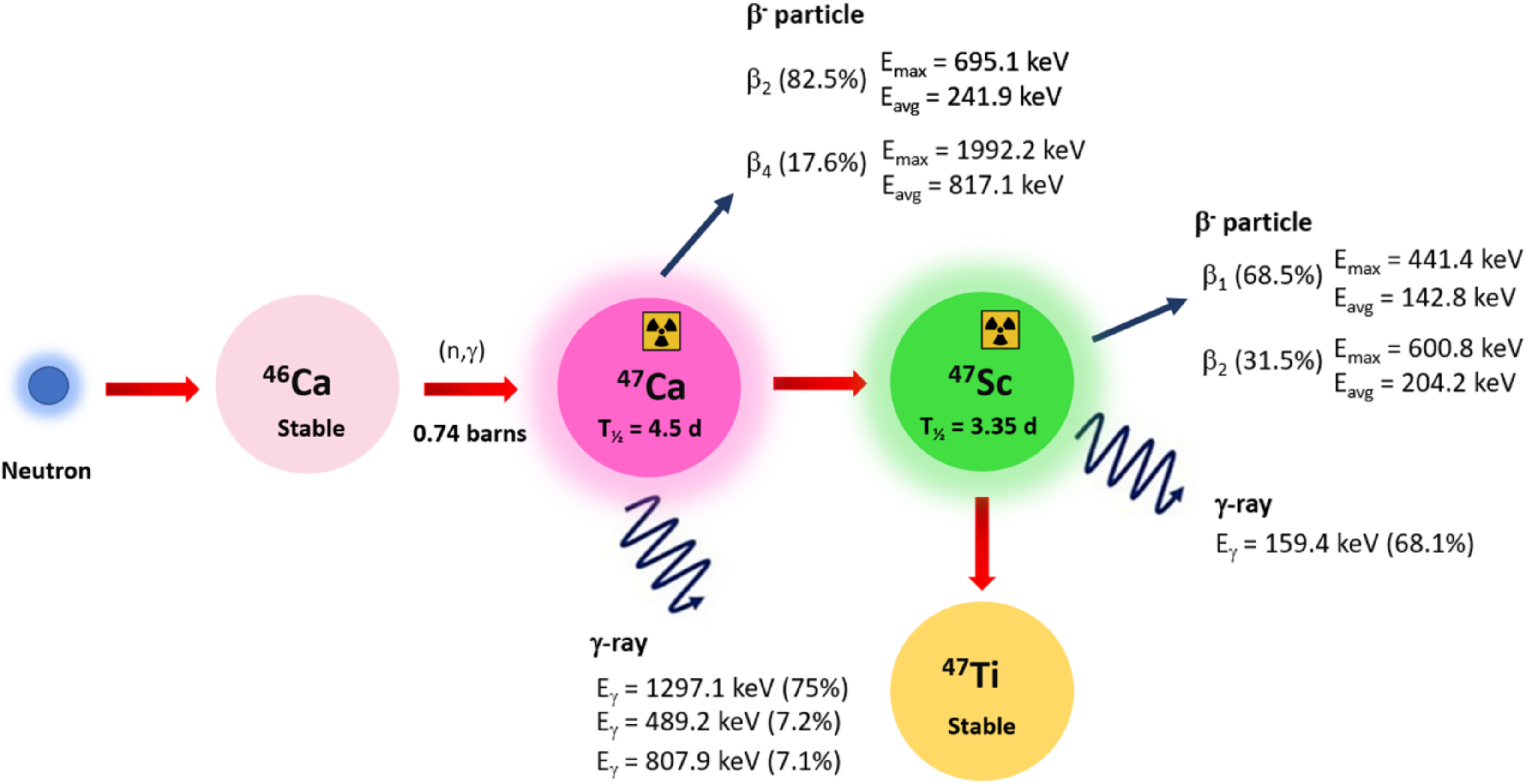
One of the isotopes that has attracted particular attention in recent years is scandium-47. It may serve as an alternative to lutetium-177, currently regarded as the gold standard in targeted radionuclide therapy. It is a radionuclide with a relatively short half-life (approximately 3.3 days), undergoing β- decay and emitting gamma radiation. This makes it suitable both for destroying cancer cells and for imaging the distribution of the therapeutic dose using techniques such as single-photon emission computed tomography (SPECT). As a result, it enables simultaneous therapy and monitoring of its course, fitting into the emerging concept of theranostics.
Scandium-47 can be produced using accelerators or through irradiation with thermal neutrons in a research nuclear reactor. A team of scientists from the Radioisotope Centre POLATOM at the National Centre for Nuclear Research (NCBJ) used the MARIA reactor for this purpose, irradiating targets with varying levels of enrichment in calcium-46. They investigated the production efficiency of scandium-47 as well as its radionuclidic and radiochemical purity depending on the enrichment level of the target material, isotopic composition, and chemical purity of the starting material.
“As a result of neutron irradiation of a target containing calcium-46, calcium-47 is formed, which subsequently decays into scandium-47. In practice, this means that scandium-47 can be obtained multiple times from a single irradiated material. The decay of the parent radionuclide leads to continuous formation of scandium-47, which can be recovered in successive separation cycles,” explains Dr. Izabela Cieszykowska from OR POLATOM, the first author of the main publication on scandium research.
In the study, up to five consecutive separation cycles were carried out over nearly three weeks after irradiation, yielding successive batches of scandium. The separation efficiency ranged from 81% to 97% for scandium-47, with calcium-47 recovery exceeding 98%. Such high process parameters were achieved thanks to the development at OR POLATOM of a highly efficient and selective method for separating scandium from calcium and other nuclear reaction products. “Analyses also confirmed the high radionuclidic and radiochemical purity of the obtained product. Scandium-47 showed high efficiency in labeling radiopharmaceuticals, including the peptide DOTA-TATE, and the resulting complexes demonstrated good stability, confirming its suitability for therapeutic applications. Quality control procedures were developed specifically for the new isotope based on the pharmacopoeial monograph used for lutetium-177,” adds Izabela Cieszykowska.
Quality analyses of the obtained radioisotope also included precise measurements of its activity and radionuclidic purity using gamma spectrometry. The studies indicated that higher enrichment of targets in calcium-46 results in greater yields of scandium, meaning that the enrichment process increases production efficiency. Analyses of stability and labeling efficiency of DOTA-TATE also suggest that higher enrichment of the target material is preferable for producing scandium-47 for nuclear medicine.
In subsequent studies conducted by OR POLATOM scientists, methods for standardizing the activity of scandium-47 using liquid scintillation (LS) techniques were developed. The use of advanced measurement methods enabled precise determination of radionuclide activity and verification of the correctness of the applied measurement procedures. The results confirmed the reliability of the developed methods and their suitability for quality control of radioisotopes intended for nuclear medicine applications. These studies constitute an important complement to work on scandium-47 production, as precise standardization of radionuclide activity is crucial both in the preparation of radiopharmaceuticals and in assessing the dose administered to the patient.
Scandium-47 produced at OR POLATOM was also used in research on a new radiopharmaceutical being developed for diagnostic and therapeutic applications in cancers, including prostate and breast cancer. “In these studies, scandium-47 was used to label a biological molecule that is a GRPR receptor antagonist, which was then subjected to detailed preclinical studies. The results confirmed the high quality of scandium-47 produced at OR POLATOM and the possibility of its use in radiopharmaceutical production,” says Dr. Izabela Cieszykowska.
The radioisotope material was provided to a research team as part of collaboration within the European PRISMAP infrastructure (European medical isotope programme: Production of high-purity isotopes by mass separation), which aims to ensure access to high-quality medical isotopes for scientific research. The results of these studies were presented at the European Association of Nuclear Medicine (EANM) Congress 2024, where the presentation of the results was distinguished and ranked among the most interesting and promising works presented at the event.
The obtained results confirm the potential of scandium-47 as a medical radioisotope and show that the technological solutions developed at OR POLATOM may play a significant role in the development of new radioisotopes that could help save patients’ health and lives in the future.
The research results are available, among others, in the following publications:
I. Cieszykowska, M. Żółtowska, D. Pawlak, Ł. Sochaczewski, Z. Tymiński, J. Marganiec-Gałązka, R. Mikołajczak, Scandium-47 as a radionuclide precursor: Feasibility of production in a 47Ca/47Sc generator-like system, Nuclear Medicine and Biology, Volumes 152–153, 2026, 109595, ISSN 0969-8051, https://doi.org/10.1016/j.nucmedbio.2025.109595.
Z. Tymiński, P. Saganowski, M. Żółtowska, I. Cieszykowska, E. Kołakowska, J. Marganiec-Gałązka, N. Lisowska, A. Kamiński, M. Czudek, D. Cacko, R. Broda, Gamma-ray spectrometry measurements for quality assessment of scandium-47 produced by neutron irradiation of calcium-46, Applied Radiation and Isotopes, Volume 229, 2026, 112408, ISSN 0969-8043, https://doi.org/10.1016/j.apradiso.2025.112408.
J. Marganiec-Gałązka, N. Lisowska, A. Kamiński, P. Saganowski, Z. Tymiński, I. Cieszykowska, M. Żółtowska. Activity standardization of Sc-47 by LS methods. Applied Radiation and Isotopes, Volume 226, 2025, 112213, ISSN 0969-8043, https://doi.org/10.1016/j.apradiso.2025.112213.
N. Kumar, A. Bilinska, E. Menéndez, T. Läppchen, ES. Moon, M. Żółtowska, D. Pawlak, I. Cieszykowska, R. Mikołajczak, F. Rösch, A. Rominger, E. Gourni. A true theranostic pair - 44/47Sc-labeled GRPR antagonist shows great promise for managing prostate and breast cancer. Eur J Nucl Med Mol Imaging. 2026 53(4):2554-2565. https://doi.org/10.1007/s00259-025-07651-y.